Reading the genomes of bacteria’s natural predators
Our research started with SEA-PHAGES genome annotation. It now covers antimicrobial resistance, cancer transcriptomics and metagenomics, with all analysis carried out computationally by undergraduates.
An answer to antimicrobial resistance
Bacteriophages are viruses that infect and kill bacteria. As drug-resistant infections spread, phages and the enzymes they make offer a promising alternative to antibiotics.
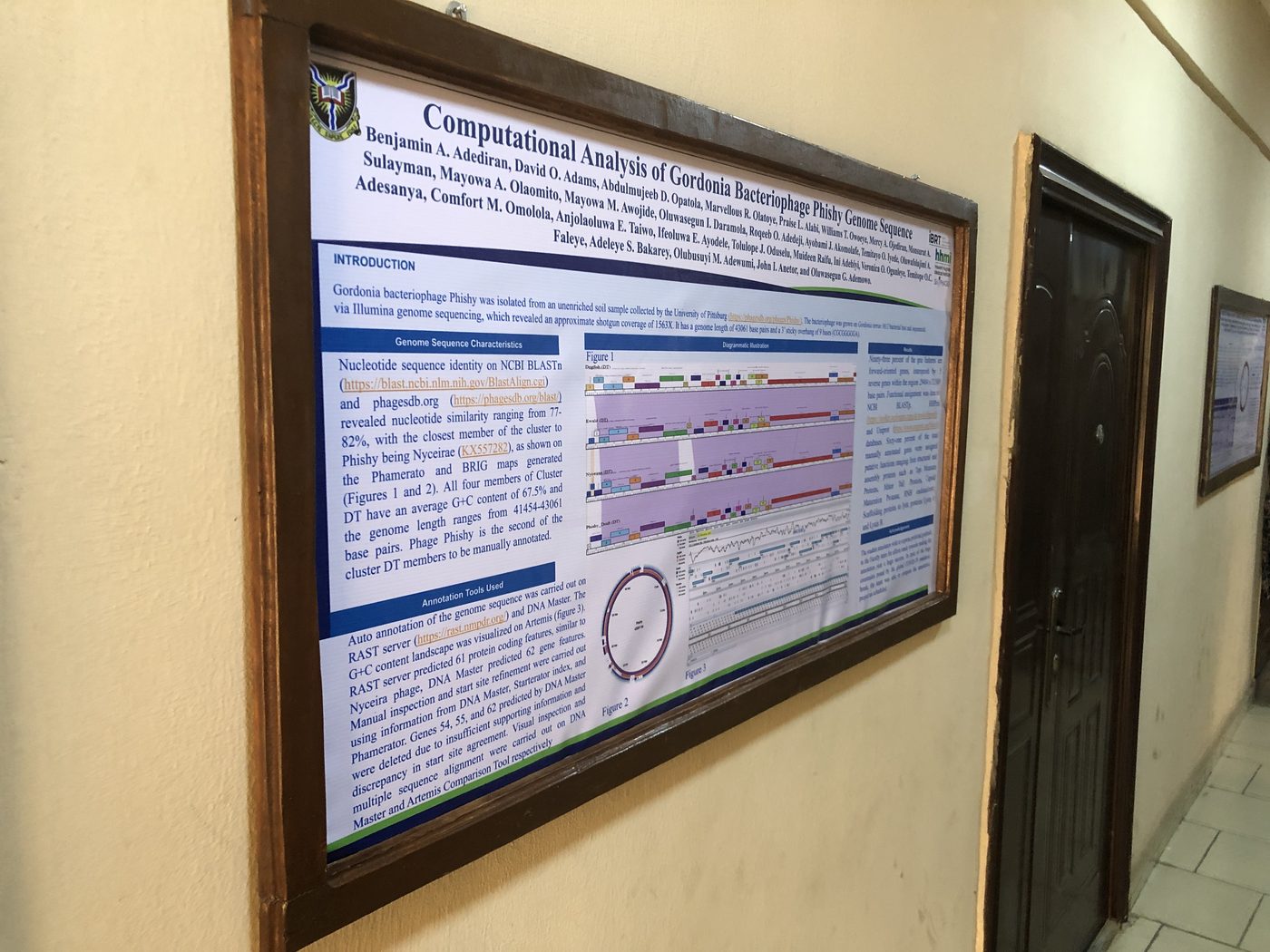
Each IBRT cohort works through a genome in detail. Members call genes, check start sites, assign functions and compare the genome with related phages. The finished, quality-checked annotations go to the NCBI GenBank and the HHMI-curated Actinobacteriophage Database, where they stay as a permanent contribution to science.
“The fact that you have been able to submit isolates to the GenBank means that it will always be in that database forever… I will say that is the greatest achievement.” Prof. O.G. Ademowo
Eight genomes, permanently on record
Every phage below was annotated by IBRT undergraduates under faculty supervision through the SEA-PHAGES programme.
- Accession
- MK757448
- Annotated
- 2019
- Team
- Pioneer cohort (2k18)
- Accession
- MT451985
- Annotated
- 2020
- Team
- Second cohort (2k19)
- Accession
- MW822146
- Annotated
- 2021
- Team
- Third cohort (2k20)
- Accession
- MW862986
- Annotated
- 2021
- Team
- Third cohort (2k20)
- Accession
- NCBI submitted
- Annotated
- 2021
- Team
- Third cohort (2k20)
- Accession
- NCBI submitted
- Annotated
- 2021
- Team
- Third cohort (2k20)
- Accession
- NCBI submitted
- Annotated
- 2022
- Team
- 2022 research year
- Accession
- NCBI submitted
- Annotated
- 2022
- Team
- 2022 research year
Tools we use: DNA Master · GeneMarkS · Phamerator · Starterator · BLAST · HHpred · Artemis & the Artemis Comparison Tool · RAST
Four groups, one training model
From Year 2, each member joins one working group and stays with it through to the end of training. There they design and carry out the group’s projects.
Bacteriophage Research Group
This is the core SEA-PHAGES work: annotating and comparing actinobacteriophage genomes. Recent projects include Gordonia phages Bianmat and Salvador, and reviews of phage endolysins, depolymerases and anti-CRISPR systems.
- Complete genome annotation and comparative genomics
- Phamerator maps and gene-start analysis with Starterator
- Reviews on phage therapeutics and diagnostics
Antimicrobial Resistance Group
This group carries out genomic surveillance of Klebsiella pneumoniae from Nigeria, using public genomes from PathogenWatch. It measures how common AMR determinants are, the role of plasmids and mobile genetic elements, and how resistant lineages are related.
- PathogenWatch, Kleborate, ResFinder and ICEfinder pipelines
- Comparison against the MGH 78578 reference strain
- Manuscripts on hypervirulent, hypermucoid blood isolates
Cancer & Transcriptomics Group
This group trains members in RNA-sequencing analysis, from the genetic basis of oncogenesis to running full transcriptomic pipelines on Galaxy and BioJupies.
- Modules on FASTA/FASTQ, SAM/BAM and quality scores
- Differential expression and MultiQC reporting
- 2022 study on CAR T-cells targeting EpCAM
Metagenomics Group
This group maps prophages and antibiotic-resistance genes (ARGs) in gut metagenomes from non-human primates. It looks at which antibiotic classes those ARGs act against.
- Prophage detection with PHASTER
- Functional resistome profiling with ResFinderFG
- Data drawn from the Ibadan Enterovirus Project and ENA
Our model, beyond our team
The Phage Leaders Forum oversees projects that take IBRT’s training approach to other departments.
Ibadan Enterovirus Project
This metagenomics project with the Department of Virology began in June 2021. Members analyse viral metagenomes from non-human primates. The work runs from assembly quality checks through to identifying phage sequences, resistome profiling and preparing manuscripts.
KBase · vConTACT · QUAST · VirSorter2 · CheckV · RASTk · MetaPhinder · PHACTS · ResFinder · VirulenceFinder
BAMSSA Research Hub
This is the flagship research programme of the Faculty of Basic Medical Sciences Student Association, and the first of its kind in any faculty at UI. IBRT designs and teaches its training in basic research, computational studies, AMR and cancer research. Students from Biochemistry, Physiology and BMLS take part.
Have a dataset, a question or a collaboration in mind?
We welcome research partnerships with laboratories, consortia and industry that share our interest in phages and AMR.