From eleven volunteers to Africa’s leading undergraduate phage team
IBRT began as an optional extension course and grew into a research organisation with its own constitution, journal and international symposium.
Why we exist
“To build an undergraduate research community of early career researchers who are enthusiastic about bacteriophage biology and its prospective use as alternative antimicrobial therapy.”
Our constitution sets out a bigger goal too. IBRT wants to be the leading undergraduate research organisation at the University of Ibadan, and to lead undergraduate research in bacteriophage biology and computational genomics across sub-Saharan Africa. We work towards this through experiments, healthy and lasting mentorship, and learning that is student-driven and adventure-based.
Motto: “…adventure-based, student-driven research engagement”
What guides our work
Mentored community
A faculty-guided, student-driven research community, held together by healthy mentor-mentee relationships.
Early-career engagement
Getting students actively involved in biomedical research early, and training researchers par excellence.
New knowledge
Exploring new fields, improving existing research ideas, and designing better workflows and pipelines.
Collaboration for health
Collaborative research among students and with established scientists, to help advance human health.
The IBRT journey
Key moments taken from the team’s constitution, the PHAMILIA journals and our conference records.
- 2018
The Ibadan Phage Hunters are born
The University of Ibadan joined HHMI’s SEA-PHAGES programme as a 13th-cohort member. It was only the second Nigerian university on the programme, after the University of Lagos. Prof. O.G. Ademowo and seven faculty colleagues brought together 11 volunteer 300-level Biomedical Laboratory Science students, led by pioneer team lead Tolulope J. Oduselu.
Because a new course would take years to approve, the training ran as a voluntary extension of MLS 301.
- 2019
First genome and first symposium
The team annotated phage Idaho (MK757448) and submitted it to NCBI. Its first two abstracts went to the 11th SEA Symposium at HHMI’s Janelia Research Campus. A second cohort then annotated phage Dothraki.
- 2020
A pandemic turned into a breakthrough
COVID-19 closed the campus, so the team designed what has been called the first undergraduate-designed virtual training course for SEA-PHAGES. It also published its first two review papers. Tolulope Oduselu became the youngest honoree on ESCMID’s “30 under 30” list. In October, IBRT hosted Africa’s first undergraduate-led World Phage Week webinar, which drew more than 160 participants from 17 countries.
- 2021
Six genomes and a journal
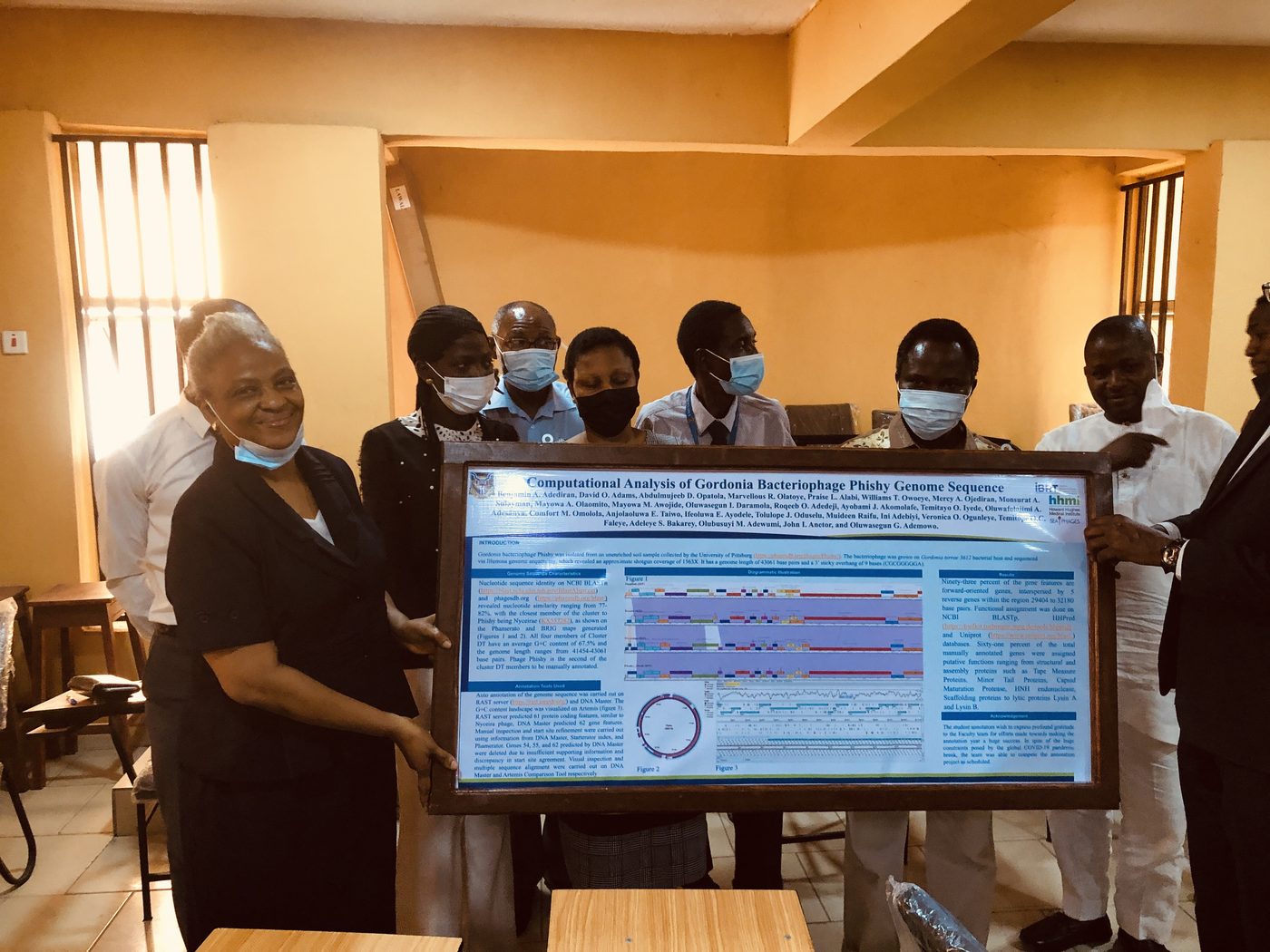
Phages Sedona, Phishy, Gretchen and Popper brought the library to six genomes. The team presented three abstracts at the 12th SEA Symposium, a first for an African university, and 23 abstracts and articles that year. It also launched PHAMILIA, Africa’s first undergraduate phage journal, and received the Vice-Chancellor’s commendation at convocation.
- 2022
Branching out
Under team lead Oluwasegun Isaac Daramola, IBRT added AMR, Cancer & Transcriptomics and Metagenomics working groups. It annotated Bianmat and Salvador, joined the Wellcome SEDRIC consortium, began its Twitter Spaces series and published PHAMILIA 2.0.
- 2023–25
Growing the training model
New Phage Leaders took the three-year course forward with Year 2 and Year 3 modules on literature review, study design and scientific writing. World Phage Week continued as a livestreamed webinar series in 2024 and 2025.
- 2026
A symposium for 1,000 phage enthusiasts
Under team lead Akintade Temiloluwa, World Phage Week becomes a hybrid symposium at the University of Ibadan. Volume 3 of PHAMILIA will launch there.
Four levels of leadership
The IBRT Constitution sets up a clear structure in which students run the team every day and faculty provide oversight.
- Faculty Team: the highest decision-making body. It supervises all research and approves programmes and collaborations.
- Alumni Body: graduates in good standing who advise, train, edit PHAMILIA and open doors to opportunities.
- Phage Leaders Forum: 8–10 Year 2 and Year 3 members who run the team, deliver training and manage outreach.
- Sub-group & committee heads: lead annotation sub-groups and ad-hoc committees.
Honours & firsts
ESCMID 30 under 30
The pioneer team lead was the youngest honoree, and the second African, on ESCMID’s list of distinguished scientists under 30.
Featured on seaphages.org
Our Phage Directory guest article, “A SEA-PHAGES team with a difference”, was featured by SEA-PHAGES. That made UI the only African university to be featured.
Africa’s first undergraduate phage journal
PHAMILIA (2021) was widely praised by the international bacteriophage research community.
First undergraduate phage conference in Africa
The World Phage Week Webinar Series has welcomed more than 1,000 participants from over 40 countries.
SEDRIC member
The only undergraduate team registered with the Surveillance and Epidemiology of Drug-Resistant Infections Consortium (Wellcome).
International memberships
Members belong to bodies including BSAC, ISVM, ASM, ASBMB, ASLM and the Microbiology Society.
Ready to start your research journey?
Recruitment opens each year for 300–500 level Biomedical Laboratory Science students at the University of Ibadan.